
Search evidence and choose the next action
This page is for the moment after a manager asks, “What do we know, and what should we do next?” Foodism Claw is most useful when it searches evidence, shows citations, and turns that into one practical move for the store.
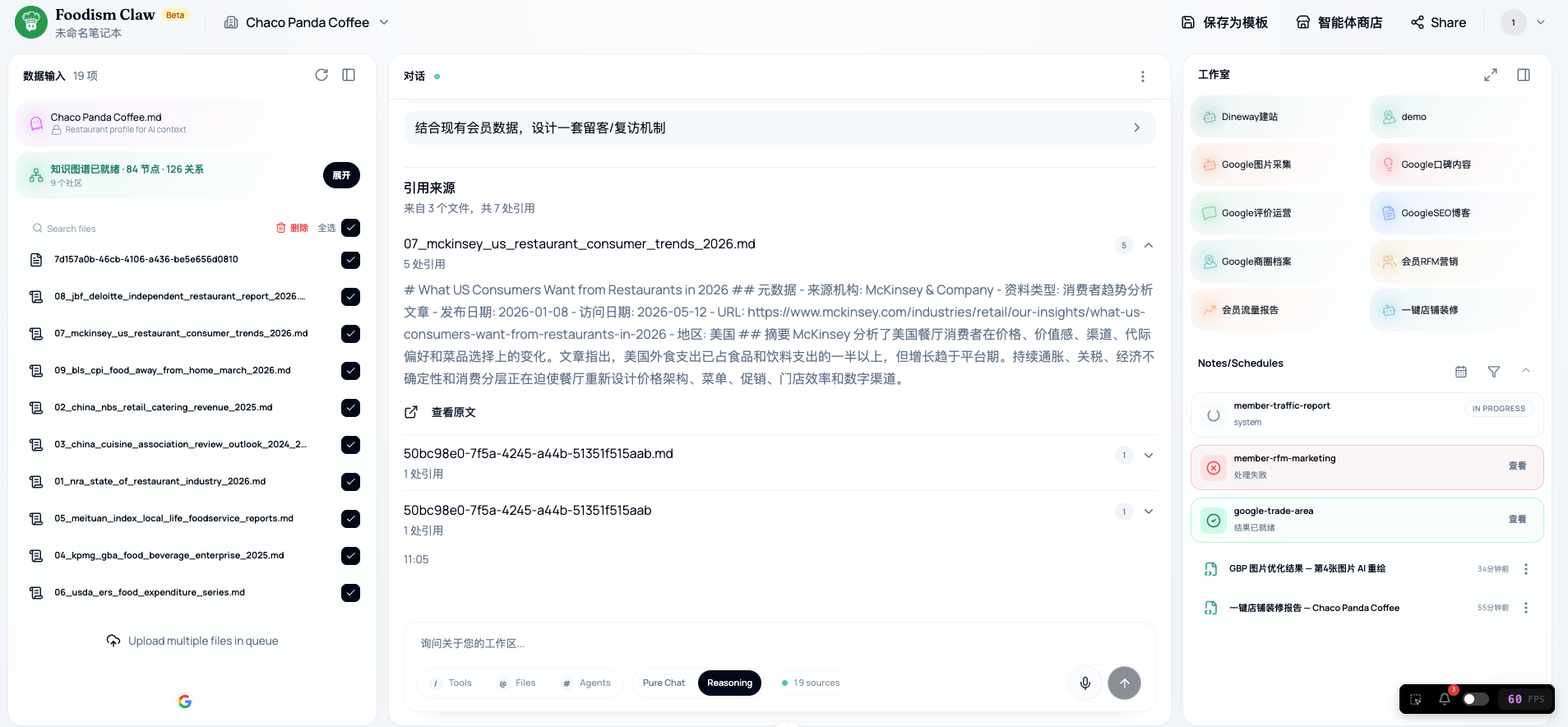
What QA/Search is actually doing
Section titled “What QA/Search is actually doing”The page is not a generic chat box. It is an operator workflow that combines live retrieval with a maintained merchant knowledge file.
| Layer | What it pulls from | Why it matters to operators |
|---|---|---|
| Live evidence retrieval | Diagnosis findings, Google profile data, reviews, uploaded menus, trade-area reports, and agent deliverables | Helps answer today’s question with current facts |
| Merchant wiki context | soul.md and enriched merchant profile notes | Keeps stable business context, signature dishes, positioning, and known facts in one place |
| Cited answer cards | Source references and preview links in the workbench | Lets the operator check the original evidence before acting |
| Deliverable preview | Generated plans, drafts, or reports in the right panel | Makes it easy to move from answer to execution |
In practice this is a hybrid knowledge flow: fresh retrieval for changing signals, plus a persistent merchant wiki for accumulated context. Andrej Karpathy’s LLM Wiki note describes the same idea at a higher level: do not rediscover the business from scratch on every question, keep a maintained knowledge layer between raw sources and answers.
Ask like an operator, not like a slogan writer
Section titled “Ask like an operator, not like a slogan writer”Good questions are short, evidence-seeking, and tied to a decision:
| Goal | Ask Foodism Claw | Why this works |
|---|---|---|
| Monday priority | ”If I have 15 minutes, what should I fix first today?” | Forces one ranked action instead of a long brainstorm |
| Review operations | ”Which reviews are safe to reply to now, and which need owner review?” | Separates routine replies from sensitive cases |
| Local SEO | ”Which missing profile field is most likely hurting search or calls?” | Connects profile completeness to visibility and conversion |
| GEO content | ”What question are guests or AI answer engines likely to ask about this store?” | Helps prepare content that is clear in Google and AI-generated answer surfaces |
| Menu clarity | ”Which dishes or menu facts are mentioned often enough to feature this week?” | Grounds content in repeated evidence, not guesswork |
| Competitor watch | ”Which nearby search terms or competitors deserve attention this week?” | Moves from generic SEO talk to local market action |
| Website check | ”What should we update on the website before we share it?” | Catches mismatch between public facts and landing pages |
Weak questions are too vague:
- “Make us popular.”
- “Do marketing.”
- “Tell me everything.”
Better: “Which one issue is most likely to affect visits, trust, or orders this week?”
The source mix behind a good answer
Section titled “The source mix behind a good answer”When QA/Search is working well, each answer combines changing signals with slower-moving store context.
| Source type | Example use in QA/Search |
|---|---|
| Diagnosis findings | Prioritize missing hours, weak photos, broken links, or low-trust profile gaps |
| Google reviews | Find repeated praise, complaint themes, and reply candidates |
Merchant wiki (soul.md) | Reuse stable facts such as signature dishes, audience, tone, and brand framing |
| Trade-area or SEO reports | Check search demand, nearby competition, and map visibility patterns |
| Uploaded files | Read menu PDFs, owner notes, event briefs, or promo documents |
| Agent deliverables | Reuse plans, summaries, and drafts instead of asking the same question again |
This matters for SEO and GEO because restaurant answers often need both:
- current signals, such as today’s reviews or missing profile fields
- compiled context, such as what the restaurant really sells and how it should describe itself consistently
How to judge whether an answer is safe to use
Section titled “How to judge whether an answer is safe to use”Before acting, check four things:
- Does it show which sources it used?
- Does it separate fact from suggestion?
- Does it lead to one practical next step?
- Does it ask for human confirmation when price, address, hours, offers, or sensitive reviews are involved?
If the answer feels generic, narrow the scope:
- “Use only the diagnosis result.”
- “Use only recent Google reviews.”
- “Compare reviews with soul.md before answering.”
- “Separate today’s action from this month’s content ideas.”
- “Write this as a task for the right assistant.”
Typical SEO and GEO questions
Section titled “Typical SEO and GEO questions”For restaurant teams, SEO and GEO are not abstract channels. They are questions guests ask before they visit, order, or trust the place.
| Operating need | Good QA/Search prompt |
|---|---|
| Google ranking support | ”Which missing public facts should we fix first to improve search trust?” |
| AI answer readiness | ”If someone asks what this restaurant is known for, what can we answer from evidence?” |
| Review-driven content | ”Which review themes are strong enough to turn into a post or website headline?” |
| Competitor awareness | ”What nearby competitor pattern should we react to this week?” |
| Website consistency | ”Where do the profile, reviews, and website tell different stories?” |
When to stop asking and start a task
Section titled “When to stop asking and start a task”Use QA/Search to decide. Then hand work off when the answer is clear.
| If the answer says… | Next move |
|---|---|
| The profile has missing or wrong facts | Start Google Store Decoration |
| Reviews need replies or triage | Start Google Review Ops |
| There is a clear local content angle | Start SEO Post Generator |
| The issue is neighborhood, competitor, or search demand | Start Google Trade Area Analysis or Google SEO Audit |
| The website is incomplete or mismatched | Start Dineway Site Builder or a website update task |
QA/Search is valuable because it reduces repeated guesswork. Ask once, inspect the evidence, then either act yourself or start the right assistant with a narrower brief.